If you run a valve repair shop, you have probably had this experience: a valve comes in for testing after overhaul, and the test bench you have cannot hold it — or cannot reach the pressure the test calls for.
That is not necessarily a fault in the bench. It usually points to the selection step: the headline numbers on a test bench — its model name, its maximum pressure — describe what it can do under specific conditions. They do not tell you whether it fits your valve.
Here are the three checks that decide whether a test bench fits, and why each one matters.
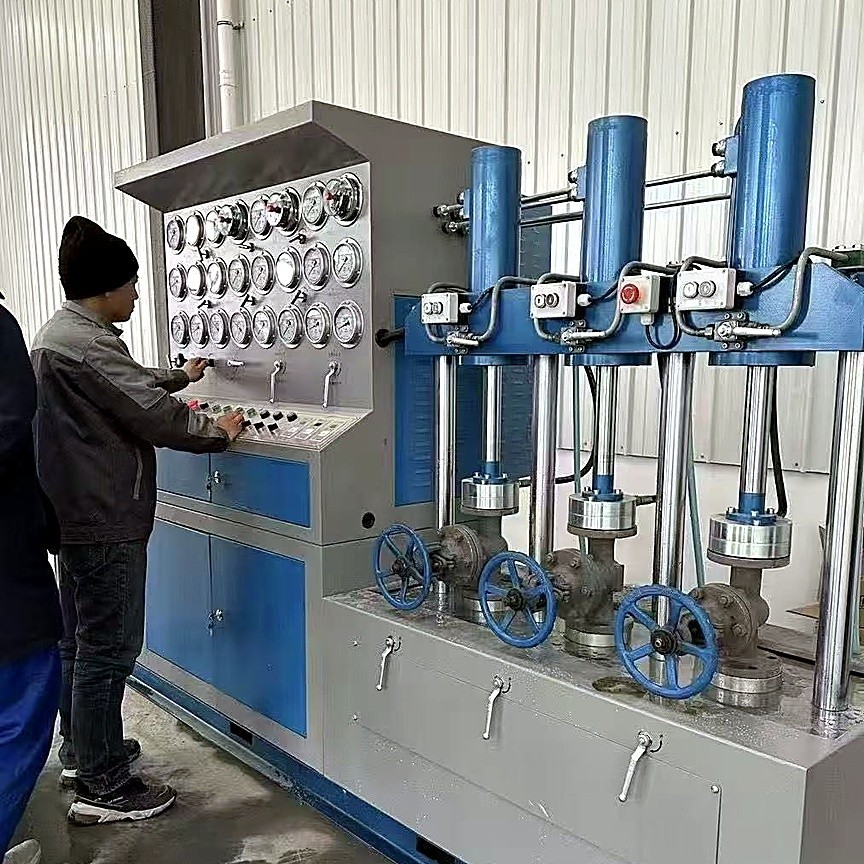
A test bench's maximum pressure is usually quoted for its smallest sizes. As the valve size grows, the pressure the bench can deliver falls.
Take our horizontal test bench, the SYTW400/4-32, for DN50–400 valves. Its test pressure by valve size is: DN50–100 up to 31.5 MPa; DN150, 22.5 MPa; DN200, 15 MPa; DN250, 9.6 MPa; DN300, 7.5 MPa; and DN350–400, 3.75 MPa.
So a bench rated "up to 31.5 MPa" does not test every valve at 31.5 MPa. If the valve you need to test is DN300, the pressure available for that size is 7.5 MPa.
Before selecting a bench, check the test pressure your valve actually requires — shell test, seat test, or the standard your customer asks for — against the pressure the bench delivers at that valve size, not against the headline number.
Check the pressure at your DN, not the pressure on the brochure.
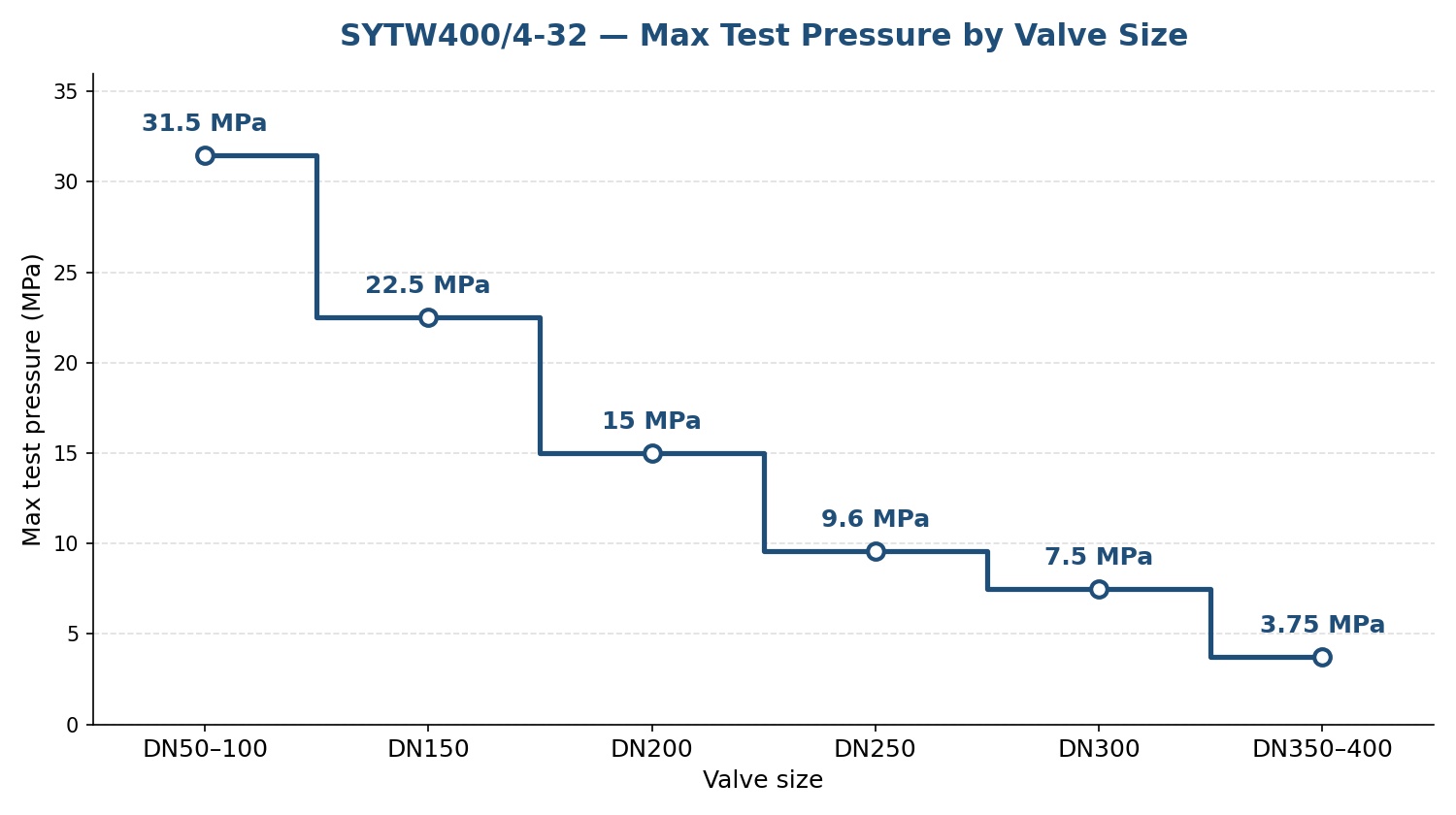
Pressure is only half the job. The bench also has to hold the valve securely while the test runs.
Three dimensions decide this:
Face-to-face length: the valve has to fit between the sealing discs. For the SYTW400/4-32, the face-to-face range is 178–600 mm, with sealing-disc spacing of 150–700 mm. A valve shorter or longer than this range cannot be clamped on this bench.
Flange size: the flange diameter must fit the bench — for the SYTW400/4-32, flange diameter up to 650 mm.
Clamping force: the bench must press the sealing discs against the flanges hard enough to hold the test pressure without leaking at the connection. The SYTW400/4-32 provides a maximum clamping force of 72 ton-force (approx. 706 kN).
A valve that fits the pressure table but not the clamping range still cannot be tested. Check both before you order.
Check the clamping range, not just the pressure.
A test bench is not a standalone tool. It needs the right power, the right medium, and the right environment to run.
For the SYTW400/4-32: power supply AC 380 V / 50 Hz / 3-phase / 4-wire, with a 220 V / 24 V control circuit, and rated power 8.5 kW. The test medium is water, and the hydraulic system uses L-HM46 oil, with an operating oil temperature of 15–60 °C. The bench is rated for an ambient temperature of 5–40 °C.
If your workshop runs on a different supply, or the bench will work outdoors in winter, confirm these conditions before deciding. A bench that cannot be powered or kept within its working conditions is no use during a shutdown, however well it fits on paper.
Check the site before the shutdown.
If you are checking a test bench for a specific valve, please share these five details instead of just the DN:
1. Valve size (DN) and the test pressure the valve requires
2. Face-to-face length of the valve
3. Flange diameter and flange thickness
4. Available power supply and relevant site conditions
5. Test medium available on site
A photo of the valve and its nameplate can help with a preliminary assessment, but it does not replace measurements. Please also provide the key dimensions or a valve drawing where available.
These details can help narrow down the model at a preliminary stage. Final confirmation still requires checking the valve geometry, the required test pressure, the clamping range, the power supply, and site accessibility.
The headline pressure is where selection starts. It should never be where it ends.
If you are selecting a test bench for a specific valve, contact us at sales@metalskingdom.com with the five details above.
Copyright © Metals Kingdom Industry Limited All Rights Reserved